
In 2026, two of the most prominent options among visual website platforms are Webflow and Framer. Webflow has been a leading no-code website builder since its launch in 2013, while Framer, originally introduced in 2013 as a prototyping tool, has been our preferred platform since 2020.
Both let teams design, publish, and manage websites without relying on engineers for every update, but they approach the workflow differently. Framer centers its experience around a flexible visual canvas, while Webflow combines visual design with a more structured website-building environment.
This guide compares Framer vs. Webflow and highlights the best Webflow alternatives for marketing, design, and growth teams choosing between Framer and Webflow for company websites, campaign pages, and content-driven sites.
Webflow vs. Framer: The Quick Verdict
Framer is better for marketing teams that need to turn a design into a live campaign page quickly. Webflow is better for teams that run a large, content-rich site with many pages, editors, or languages over several years.
- Framer costs less to start: $10/month for Basic vs. $15/month for Webflow Basic, which has no CMS.
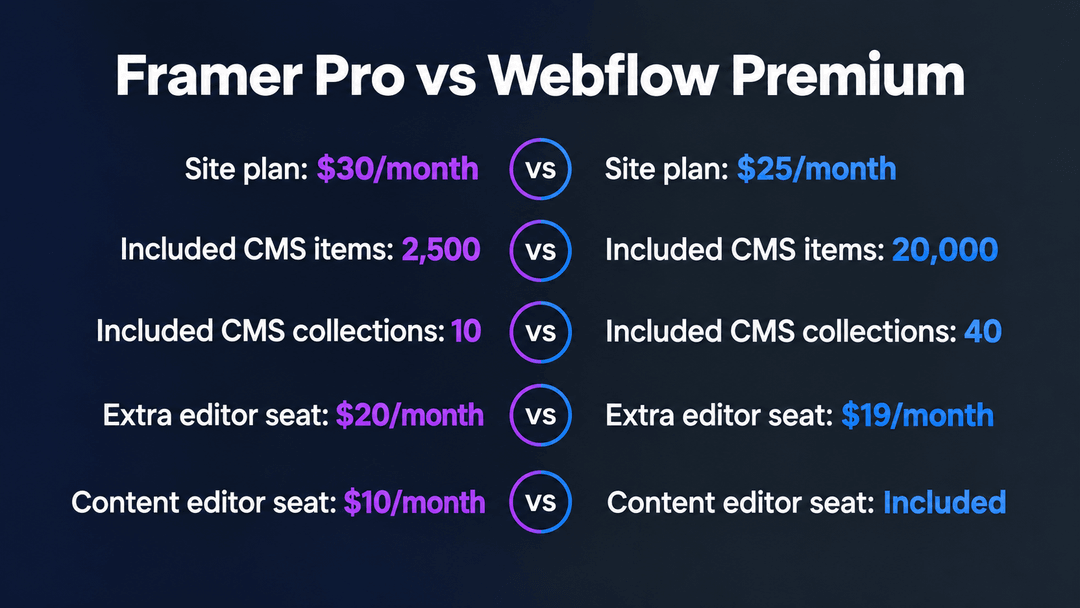
- Webflow gives more CMS capacity per dollar: 20,000 CMS items on its $25/month Premium plan vs. 2,500 on Framer’s $30/month Pro plan.
- Pick Framer for campaign pages, product launches, and design-led sites that change every week.
- Pick Webflow for content hubs, multi-market sites, and teams that need strict permissions.
 webflow vs framer pricing plans
What is the main difference between Webflow and Framer?
The main difference is the workflow. Framer is a canvas-first website builder: you go straight from a visual design to a published page. Webflow is a structured visual development platform. It’s built around class-based styling, reusable components and a relational CMS.
Framer: Visual idea → Design on canvas → Add content → Publish Webflow: Content model → Design system → Templates → Manage content → Scale
- Framer puts speed first. It bundles a canvas, CMS, SEO controls, forms, analytics and hosting in one tool.
- Webflow puts structure first. Its class system, CMS collections and Localize add-on suit sites with many page types, editors and markets.
Framer builser isn’t only for one-page sites, and Webflow isn’t only for technical teams. The difference is what each platform makes easy by default.
Which to pick: if your team thinks in layouts and campaigns, start with Framer. If it thinks in content types and templates, start with Webflow.
Who should use Framer and who should use Webflow?
Both tools let you build custom sites and landing pages without writing code. But they’re made for different people and different project sizes.
Framer: the designer’s fast track
Framer is built for visual designers, creative studios and early-stage founders. They care most about speed, looks and quick iteration. Framer works a lot like Figma: you draw on a canvas and publish straight to the web.
- Who uses it: UI/UX designers, solo founders, freelance creators and small agencies.
- What they build: startup landing pages, portfolios, event sites and MVP sites.
- Why they choose it: anyone who knows a modern design tool picks it up fast. Animations and interactions come out of the box. A polished site can go live in hours, not weeks.
Webflow: a visual engine for structured sites
Webflow is for teams that need fine control over site structure, content at scale and integrations. It’s a visual way to write real HTML, CSS and JavaScript. So users need to understand the box model and basic web development.
- Who uses it: front-end developers, enterprise marketing teams, larger web agencies and content managers.
- What they build: large corporate sites such as Dell and Rakuten, ecommerce stores, high-traffic blogs and marketing hubs connected to many tools.
- Why they choose it: this CMS handles thousands of dynamic pages. The API and integrations, like Zapier, connect the site to CRMs and the rest of the marketing stack.
Which to pick: Framer suits designers and small to mid-sized teams who need to ship fast. Webflow suits teams with many editors, lots of content or several markets.
Webflow vs Framer comparison
In a nutshell: Framer wins on speed from design to live page. Webflow wins on CMS capacity, permissions and multi-market structure.
| Feature | Framer | Webflow |
|---|---|---|
| Building model | Visual canvas, components, animations, React extensions | Visual Designer, reusable components, class-based styling, structured CMS collections |
| Entry price | Basic: $10/month | Basic: $15/month |
| CMS plan | Pro: $30/month, 2,500 CMS items, 10 collections | Premium: $25/month, 20,000 CMS items, 40 collections |
| CMS ceiling | Up to 40,000 items with paid add-ons | Premium includes 20,000 items; Enterprise limits may vary |
| Pages | Pro: 150 pages, expandable to 700 | Basic: 300 static pages |
| Extra editors | $20/editor/month; $10/content editor/month; viewers free | $39/full seat/month; $15/limited seat/month; reviewer seats free |
| Localization | $20 per locale; up to 20 | Paid Localize add-on |
| Staging | Pro includes staging and branching | Free webflow.io staging |
| A/B testing | Convert add-on | Optimize add-on |
| Ecommerce | External integrations for full checkout functionality | Native ecommerce plans with checkout |
| Custom code | React code components, overrides, custom scripts | HTML/CSS/JS, React code components through DevLink |
| Apps on the same domain | Advanced Hosting reverse proxy add-on | Webflow Cloud supports Next.js and Astro apps on subpaths |
| Code export | No full-site source export | Paid Workspace export, with CMS and other limitations |
| AI | Agents, Workshop, AI translation | AI site building, content generation, SEO/AEO assistance, code components |
| Best for | Campaign pages, launches, portfolios, and design-led websites | Content-heavy websites, multi-market sites, and structured editorial workflows |
Sources: Framer pricing, Webflow pricing, Webflow code export, Webflow Cloud, Framer AI credits, Webflow Conf 2025 recap.
Webflow vs Framer pricing
Both platforms bill hosting per site. The difference is how they charge for people. Webflow charges for a Workspace plan plus seats. Framer charges per editor. That gap grows with your team.
Webflow. Every site needs a Site plan: Basic at $15/month or Premium at $25/month (Webflow pricing). Teams work together in a Workspace. Workspace plans start with Core at $19/month and Growth at $49/month. Seats cost extra: a Full seat is $39 and a Limited seat is $15. The Guest role gives an agency access to one site without a full seat (Guest role). So three brands on Premium cost 3 × $25 in Site plans, plus one shared Workspace.
Framer. Site plans are also per site: Basic at $10/month and Pro at $30/month (Framer pricing). Extra editors cost $20/month each, content editors $10/month, and viewers are free. You can stretch Pro limits with paid add-ons: $20 per 10,000 CMS items (up to 40,000) and $40 per 10 collections (up to 40).
Here’s how one content-heavy brand compares:
| Line item | Framer Pro | Webflow Premium |
|---|---|---|
| Site plan | $30/month | $25/month |
| Included CMS items | 2,500 (add $20 per 10,000, max 40,000) | 20,000 |
| Included CMS collections | 10 (add $40 per 10, max 40) | 40 |
| Extra editor seat | $20/month | Full seat $39/month, plus a Workspace plan from $19/month |
| Content editor seat | $10/month | Limited seat $15/month |
Which to pick: Framer is cheaper for a small team with a modest CMS. Webflow gets cheaper per CMS item as your content grows.
For product owners: budget for year two, not launch day. Seats, locales and add-ons often end up costing more than the site plan itself.
Webflow vs Framer CMS: limits and content modeling
On the listed plans, Webflow Premium includes 20,000 CMS items for $25/month, while Framer Pro includes 2,500 for $30/month. That gives Webflow roughly ten times the CMS capacity per dollar at the plan level. Your actual cost will also depend on editor seats, localization and other add-ons.
Webflow CMS limits that shape page design
- 100 items per Collection list. Pagination shows 100 per page. To show items 101–200 on one page, duplicate the list and set “Skip 100”.
- 40 Collection lists per page. Nested lists count, and so does every duplicated list.
- 10 nested lists per page, three levels deep at most.
- API rate limits: 60 requests per minute on Starter and Basic, 120 on CMS, eCommerce and Business plans. You can publish the site once per minute. Bulk endpoints take up to 100 items per request, so batch your syncs.
Sources: Webflow dynamic content limits, Webflow API rate limits, Webflow CMS localization API.
Framer CMS limits that shape growth
- Item and collection caps: 1,000 items and 2 collections on Basic. 2,500 items and 10 collections on Pro, up to 40,000 items and 40 collections with paid add-ons.
- Writing from outside Framer: the Plugin API only runs while the editor is open. The Framer Server API lets a script on your server update and publish the project. For example, you can sync a Notion database on a schedule.
- One destination: Framer’s CMS only feeds the Framer site. If the same content has to reach an app, a second site or a newsletter, you probably need a headless CMS.
Do CMS-generated pages count toward page limits?
No. Both platforms count static pages and CMS items separately. Unique layouts like the homepage, pricing and landing pages count against the page limit. Blog posts, case studies and other template-based pages count against the CMS item limit.
Which to pick: under a few thousand items, both work fine. Past that, Webflow’s limits and pricing hold up better.
For product owners: if your content has to feed an app, a docs site or a second brand, neither CMS is built for that job. That’s usually the point where a headless CMS starts paying for itself.
Is Webflow or Framer better for SEO?
Both can rank well. Good content and links matter more than the platform. The differences are in rendering, URL control and a few setup traps that are easy to miss until traffic drops.
How each platform renders pages
Framer turns every page into static HTML when you publish. Then React “hydrates” it in the browser. Search engines get the full HTML, so indexing isn’t the problem. The JavaScript cost is, and it shows up in Interaction to Next Paint (INP). To cut that delay, Framer only preloads the modules each page needs (technical write-up, May 2026). Heavy code components and very different breakpoint layouts still add weight.
Webflow publishes static HTML and CSS with interaction scripts on top. Page weight depends mostly on how many interactions, embeds and third-party scripts you add.
Framer SEO traps
- *.framer.app domains aren’t indexed by search engines. Always publish on a custom domain or *.framer.website.
- Setting a canonical URL requires the Advanced Hosting add-on.
- Serving Framer under a subdirectory (example.com/blog) also needs Advanced Hosting. Project page paths must match the proxied path.
Source: Framer reverse proxy guide.
Webflow SEO traps
- 301 redirects only match paths from the root domain. They don’t cover localized slugs or locale subdirectories, so each locale needs its own rule.
- You can’t redirect away from a live page. Delete it, draft it or change its slug first.
- Webflow recommends staying under about 1,000 redirect rules. Use capture groups (.*) with
%1to combine them. - Custom code is capped at 50,000 characters per head or footer slot. Host larger scripts externally.
Sources: Webflow redirects, Webflow custom code.
Which to pick: Webflow gives SEO teams more control out of the box. Framer is fine for SEO once it’s on a custom domain with a canonical set. But the controls that matter most at scale sit behind a paid add-on.
For product owners: if the marketing site has to live under your product domain (example.com/blog) or needs canonical control, budget for Framer’s Advanced Hosting from day one.
Webflow vs Framer for multilingual sites
Framer is the simpler and cheaper way to go multilingual. Webflow gives you more control over localized URLs, routing and assets on its Advanced tier. Either way, you’ll pay extra. Neither base plan is multilingual out of the box.
| Feature | Framer | Webflow |
|---|---|---|
| Price | $20 per locale per month, up to 20 locales | Localize Essential $9/month (1–3 locales, 10,000 words/month); Advanced $29/month (1–10 locales, 50,000 words/month), priced by number of locales |
| Translated URLs | Yes: “Translate Page Paths” setting, CMS slugs included | Advanced tier only |
| Visitor routing | Locale switcher | Automatic routing on Advanced and Enterprise, via 302 redirects |
| hreflang | Check the published HTML | Generated automatically in page head and sitemap |
| AI translation | Uses workspace AI credits | Included word allowance per tier |
Sources: Framer pricing, Framer localized page paths, Webflow pricing, Webflow localized SEO and routing.
A site in four or more languages needs Webflow’s Advanced tier, because Essential stops at three added locales. On Framer, Auto Translate runs on your plan’s AI credits: 1,000 a month on Basic and 3,000 on Pro.
Do translated CMS items count toward item limits?
Neither vendor clearly documents this. Webflow’s docs say each locale has its own version of a CMS item. They don’t say how those versions count against the 20,000-item cap. Framer’s pricing page is silent too. Third-party guides report that on Framer, every localized version counts as an item (Superblog). That would turn a 2,000-item site in three languages into 6,000 items.
The quickest way to find out: create one CMS item, add two locales and watch the item counter.
Which to pick: Framer if you need many languages on a tight budget. Webflow Localize Advanced if you need localized URLs, visitor routing and per-locale assets.
For product owners: get the item-count answer in writing before you sign. On a 2,000-item site in three languages, it decides whether you need 2,000 or 6,000 items of capacity.
Team Workflows in Webflow vs. Framer
Webflow offers more clearly defined permission boundaries, while Framer relies more on assigning the right roles to the right people. For a team of three, the difference may be negligible. But it becomes much more significant when agencies, freelancers, and in-house marketers collaborate on the same website.
Can an agency hand off a Webflow or Framer site to a client?
Yes, both platforms support handoffs. However, who owns the site and pays for the subscription matters more than the transfer itself.
- Webflow: Site plans are tied to individual sites, which can be transferred between Workspaces. However, the cleanest agency setup is to let the client own the Workspace and site plan from the start, then invite the agency as a Guest with site-level permissions. Guest access is limited to specific sites, can be revoked with a single click, and eliminates the need to share passwords or billing details (Guest role, Agency or Freelancer Guest role).
- Framer: Sites belong to the Workspace that manages them, and the subscription is tied to the relevant Workspace. A handoff therefore involves transferring project ownership. The cleaner approach is to build the site in a client-owned Workspace from day one.
Can freelancers edit only certain CMS collections?
Not on standard plans. Webflow Enterprise is the exception.
- Webflow: Content Editors can add, edit and publish CMS items, but they see all of the site’s collections (Content editor role). Limiting access to specific collections, pages or locales needs Enterprise custom roles (Enterprise custom roles).
- Framer: the Content Editor role covers CMS content, localization and on-page edits across the whole workspace. Collection-level access isn’t documented on Basic or Pro (Framer member roles).
Can marketers build landing pages from approved components?
Yes on both. The guardrails are different.
- Webflow: content editors can build pages from templates and components. They can’t create or change components, classes or variables, so the design system stays locked (Content editor role). On higher Workspace plans, agencies can share a component Library across sites (Webflow plan updates).
- Framer: components are the native building blocks. Content Editors publish structured content without touching layouts. But anyone with full editor access can still change components, so protection depends on who gets which seat.
Can a blog post go live without publishing a designer’s unfinished changes?
This used to be Webflow’s biggest editorial pain point. Today it’s largely solved.
- Webflow: you can publish single CMS items without publishing the whole site. Edits to live items stay in draft until you release them (Publish individual CMS items, CMS drafting improvements). A per-user “Can publish” toggle controls who can push content live. In some cases single-item publishing is blocked, for example after a collection’s structure changes.
- Framer: with staging switched on (Pro and above), any project member can publish to staging. Only members with Deploy permission can push changes to the live site (Framer member roles, Publishing your Framer site). Basic has no staging, so every publish goes straight to production.
Which to pick: if agencies, freelancers and in-house marketers share one site, Webflow’s stricter permissions are worth the extra seat cost. A small in-house team will do fine on Framer.
For product owners: make sure your company, not the agency, owns the workspace and billing from day one. It’s the cheapest insurance against vendor lock-in.
Integrations and forms in Webflow and Framer
Both platforms plug into a typical marketing stack. So don’t just count integrations. Ask who will set up each connection, who will maintain it and who will fix it when something changes.
Webflow connects through apps, its Data API and automation tools. You can route leads into a CRM or update CMS content from other systems. Framer connects through integrations, plugins, custom scripts and form webhooks.
The better fit depends on how those connections work day to day. Can your marketing team set them up alone, or will they need a developer? Does data flow one way, or do several systems need to stay in sync? Answer these first. It’s a more useful test than the number of integrations on each platform’s list.
How do you embed a form in Webflow or Framer?
- Native forms: both have a built-in form builder. Webflow allows 50 submissions on the free Starter plan and unlimited on paid site plans. Framer forms can send submissions to email or a webhook.
- Third-party forms (HubSpot, Typeform, Tally): paste the provider’s embed code into Webflow’s Code Embed element or Framer’s Embed component.
- CRM routing: use the form provider’s native integration, or a webhook into Zapier or Make. Don’t scrape submissions after the fact.
What happens to integrations when the person who set them up leaves?
Neither platform solves this for you. It’s a process problem.
- Webflow: apps, API keys and automations live at site or Workspace level. If connections sit under a shared Workspace, they survive a team change. They break when someone wires automations through a personal Zapier account or API key.
- Framer: integrations, plugins, scripts and webhooks are project settings managed by Admins. But the credentials behind them only last as long as the accounts that own them.
Which to pick: Webflow if your site has to sync data with a CRM or other systems. Framer if you mostly need forms and simple one-way connections.
Handover checklist for both: list every connection, note who owns each credential, move automations to a shared service account before launch and name an integration owner in the handover document.
Migration readiness: what can you take with you?
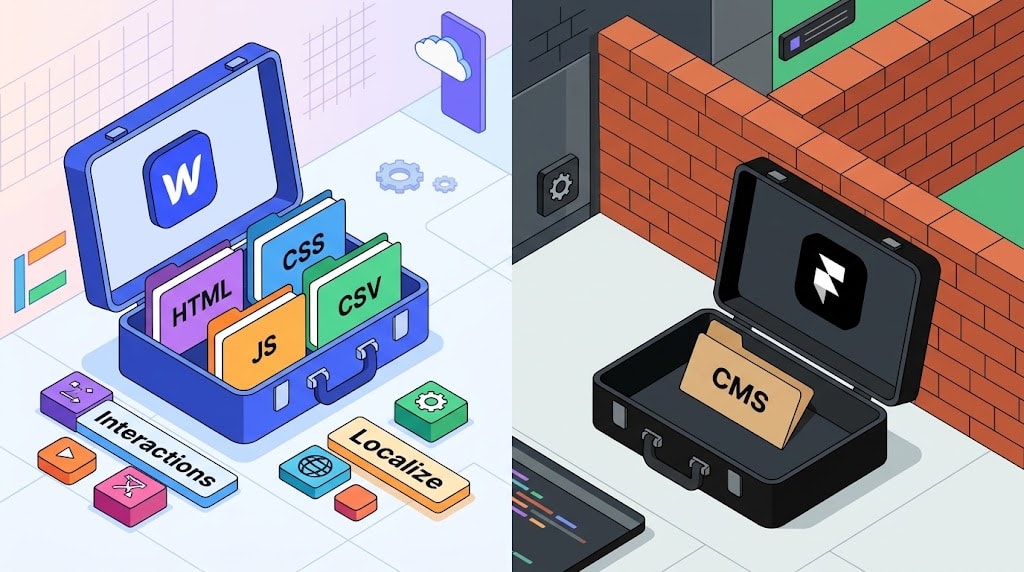
Webflow lets you export more. Framer is the tighter walled garden.
Webflow. Code export (HTML, CSS and JS) is available on paid Workspace plans. CMS content is available through the CMS API and CSV export (Webflow code export). Some things don’t survive an export: the Designer itself, interactions in editable form, CMS bindings, Localize translations and Workspace features. An export is a snapshot, not a project you can move.
Framer. There’s no full code export. You can fetch published pages as static HTML, but the project, CMS structure and components only live inside Framer (The Proof Desk, Framer review 2026). You can export CMS content, and redirects plus rollback lower the risk. Still, moving off Framer means a rebuild.
Which to pick: if you might switch platforms in a few years, Webflow leaves you with more to take along. Either way, plan any move as a rebuild, not an export.
 What fits in the suitcase (Webflow vs Framer)
Outgrown Webflow and Framer? When to move to a headless CMS
Sooner or later, some teams hit the ceiling of any visual builder. Watch for these signs:
- Your content needs to feed an app, a docs site or more than one brand.
- You keep working around CMS item caps, Collection list limits or API rate limits.
- The site needs logic a visual builder can’t handle well: authentication, personalization or pricing pulled from your product.
- Per-locale redirect and routing rules have turned into a maintenance job of their own.
At that point, a Next.js frontend with a headless CMS usually makes more sense than another plan upgrade. Sanity, Storyblok, Contentful and Payload are common choices. That’s where we come in.
At FocusReactive, we help teams move off website builders and onto a headless CMS without putting their SEO at risk. We work with everyone from early-stage startups about to outgrow their launch site to multi-market SaaS teams.
How Firsty moved from Webflow to a headless CMS
Firsty, an eSIM provider, “hit a critical technical ceiling with their existing Webflow website.” We rebuilt it on Next.js 15 and Storyblok, hosted on Vercel. Here’s what changed:
- 190+ country pages on one platform, with AI-assisted localization in 6 languages
- Live pricing pulled into regional pages from an external API, so nobody updates tariffs by hand
- eSIM checkout right on the site through the Adyen payment gateway
- Marketing works on its own, building pages and grouping countries by region without developer help
- 60% faster page publishing and 3× faster campaign launches
We handle the CMS migration end to end, including content structure, URLs, metadata and redirects. Running on Webflow today? See how we migrate from Webflow to a headless CMS. A typical project takes 4–8 weeks. Not ready to commit yet? Size up your move first with our free CMS Migration Cost Estimator.
Webflow vs Framer: final recommendation by use case
Pick Framer if your team designs first and ships often. Pick Webflow if your site runs on content, many editors and several markets. Both are solid website builders. The wrong choice is the one that fights how your team works.
| Your situation | Better fit |
|---|---|
| Launch pages, campaigns, portfolios, design-led startup sites | Framer |
| Small team, under ~2,500 CMS items, mostly designers editing | Framer |
| Many languages on a tight budget | Framer |
| Content hub or blog heading past 5,000 items | Webflow |
| Several editors who must not touch the design system | Webflow |
| Native ecommerce on the marketing site | Webflow |
| Localized URLs, routing and per-locale assets | Webflow (Localize Advanced) |
| Content that feeds an app, docs or several brands | A headless CMS |
Still unsure? Think about who will update the site a year from now. That answer usually settles it.