Selecting a headless CMS comes down to your unique needs, from flexibility and user experience to scalability and third-party integrations. In this article, we compare two popular solutions - Storyblok and Sanity. Both offer a powerful set of features, and we’ll break them down so you can decide which one suits your project best.
According to recent G2 research, both platforms continue to lead the headless CMS market in 2025, with Sanity ranking #1 out of 85 CMS platforms on G2, while Storyblok maintains its strong position as a category leader.
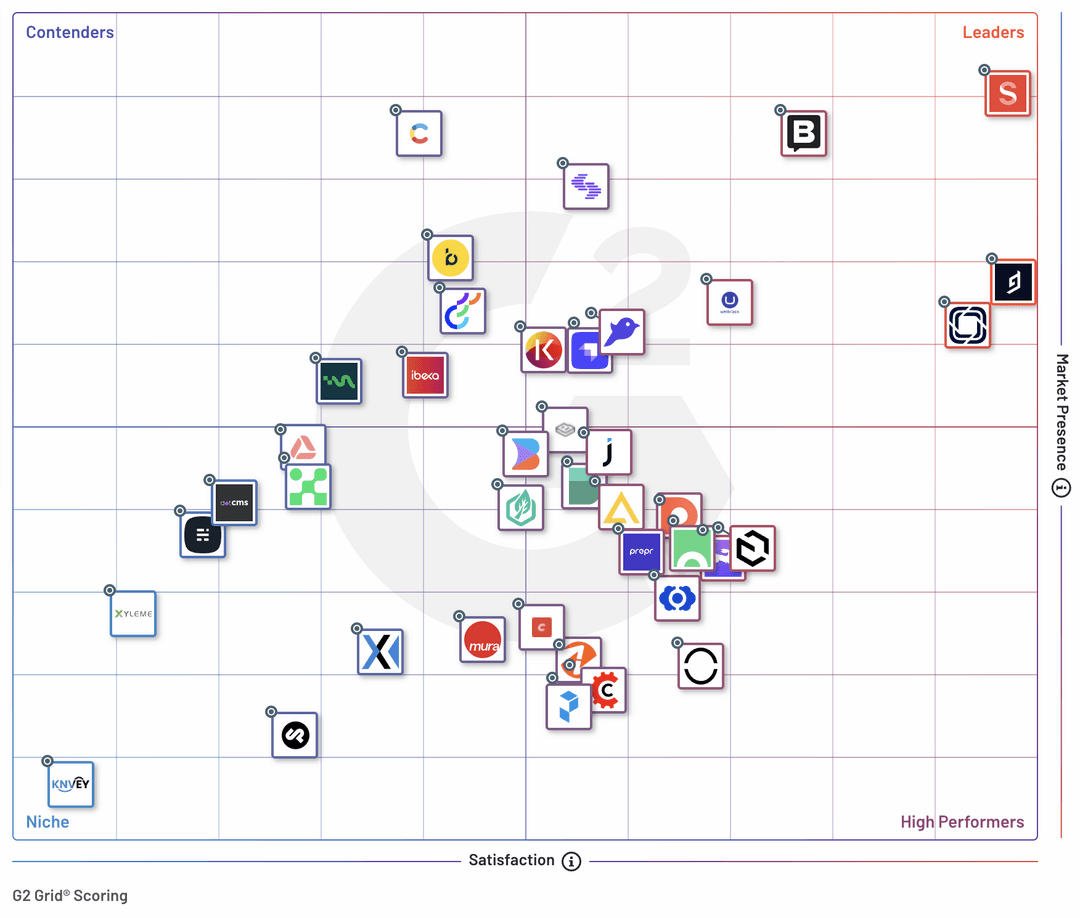 G2 Grid® for Headless CMS
Based on the latest market data, we’ll evaluate both platforms across key factors:
- Ease of use
- Content modeling
- Integration capabilities
- Scalability
- Localization support
- Developer-friendliness
- Security features
- Support and documentation
- Pricing and licensing
- AI integration
As an official integration partner for both Storyblok and Sanity, FocusReactive can guide you through each step of the process from initial setup to complex customizations.
Ease of Use
Storyblok continues to shine with its intuitive visual editor that makes content management accessible to technical and non-technical users alike. The recent launch of Storyblok Labs in January 2025 offers a playground where users can test-drive innovative features before fully integrating them into their workflows.
Sanity maintains its reputation for flexibility with a highly customizable interface that can be tailored to specific workflows. Their 2025 updates further enhance the platform’s customization options, allowing teams to create precisely the content environment they need.
Content Modeling
Storyblok’s structured approach to content modeling, powered by its visual editor, remains one of its strongest selling points. The system makes it straightforward to create and maintain content models without extensive technical knowledge.
Sanity continues to offer unmatched flexibility in content structuring, with recent improvements to its schema system providing even more control. Their “Content Operating System” approach gives developers extensive freedom to design content structures that perfectly match project requirements.
Integration Capabilities
Storyblok’s plugin ecosystem has grown significantly, offering even more integrations with frontend frameworks, APIs, and third-party services. Their eCommerce integrations, particularly in the Business plan, have been enhanced to meet growing enterprise demands.
Sanity maintains its developer-focused approach with solid APIs and integrations that enable smooth connection with virtually any tech stack. Their commitment to being a “Content Operating System” rather than just a CMS continues to attract technically-minded teams seeking full control.
Scalability
With its cloud-based infrastructure, Storyblok handles high-traffic situations and growing content needs effectively, as demonstrated in numerous enterprise case studies. Their architecture continues to evolve to support demanding enterprise requirements.
Sanity’s flexible architecture scales smoothly for projects of any size, from small startups to global enterprises. Their real-time capabilities and content infrastructure approach provide reliable performance even as content needs expand.
Localization
Storyblok offers advanced built-in multilingual capabilities that simplify content management across multiple languages and regions. Their localization tools have become increasingly powerful, making them a go-to choice for global brands. For practical implementation tips, check our detailed guide on Storyblok localization best practices.
Sanity’s customizable approach to localization continues to provide flexibility for organizations with complex international content requirements. Teams can build precisely the localization system that matches their specific regional needs.
Developer Experience
Storyblok provides developers with clear documentation, framework-specific guides (Next.js, Vue, Nuxt, React, Astro), and a wide range of APIs. The platform balances developer flexibility with an intuitive content editor, making it accessible for technical and non-technical team members.
Sanity continues its developer-first approach with extensive customization options, powerful APIs, and a code-centric philosophy. Its flexible content modeling, GROQ query language, and active Slack community make it particularly appealing to teams who prioritize technical control and customization.
Security
Both platforms have strengthened their security measures for 2025’s evolving threat landscape.
Storyblok Security
Storyblok prioritizes enterprise-grade security through:
- Solid Infrastructure: Hosted on AWS with ISO 27001 certification
- Data Protection: Encryption in transit and at rest with regular backups
- Access Controls: Monitored access with authentication via SSH key pairs
- Threat Protection: Web application firewall (WAF) against XSS and other attacks
Sanity Security
Sanity offers a thorough security approach with:
- Granular Access Control: Fine-grained permissions through user roles
- Authentication Options: Support for OAuth2 and SAML SSO
- Data Protection: Secure token management
- API Security: Secure patterns for content submission and validation
Support and Documentation
Storyblok offers well-organized documentation alongside a growing community with Discord, GitHub, and YouTube channels. Their Ambassador program and regular webinars offer additional learning opportunities.
Sanity maintains detailed documentation with an active Slack community where developers can get quick answers to technical questions. Their extensive learning resources continue to serve developers at all skill levels.
Pricing and Licensing
Storyblok offers a 14-day free trial and a tiered pricing model tailored for teams of different sizes and levels of complexity. Each plan includes a visual editor and collaboration tools, with add-ons for team members and traffic as needed.
Storyblok Pricing (Updated for 2026)
Storyblok recently adjusted its pricing structure (effective April 2026), expanding its AI capabilities and introducing new collaboration tools. Notably, AI credits and the AI Suite are now a standard offering across all plans, rather than being restricted to enterprise tiers.
- Starter (Free): Aimed at freelancers and small teams, this free tier provides essential content management capabilities.
- Growth (€99/month): The entry-level commercial plan includes 1 Space, 5 user seats (expandable up to 10 for €15/month each), and 400GB of traffic (with an option to add 250GB for €75). It features the Visual Editor, Storyblok Labs, collaboration tools, and the newly added Ideation Room.
- Growth Plus (€349/month): Designed for scaling teams, this tier includes 15 user seats (expandable up to 20 for €15/month each) and 1TB of traffic. It unlocks Single Story Scheduling, access control via Standard Roles, and a 97% Uptime SLA.
- Premium (Custom Pricing): Unlocks a custom number of user seats and all self-service features. It introduces AI SEO, GraphQL, Custom Roles & Workflows, release management, SSO, a 99.9% Uptime SLA, and usage-based billing with advanced support.
- Elite (Custom Pricing): The highest enterprise tier includes all Premium features plus unlimited Stories, assets, and version retention. It offers priority support, frequent backups, Access Token Scopes, custom IP restrictions, and a 99.99% Uptime SLA.
Sanity Pricing (Updated for 2026)
Sanity’s pricing model scales differently, focusing heavily on developer API usage and a per-seat license for mid-market teams.
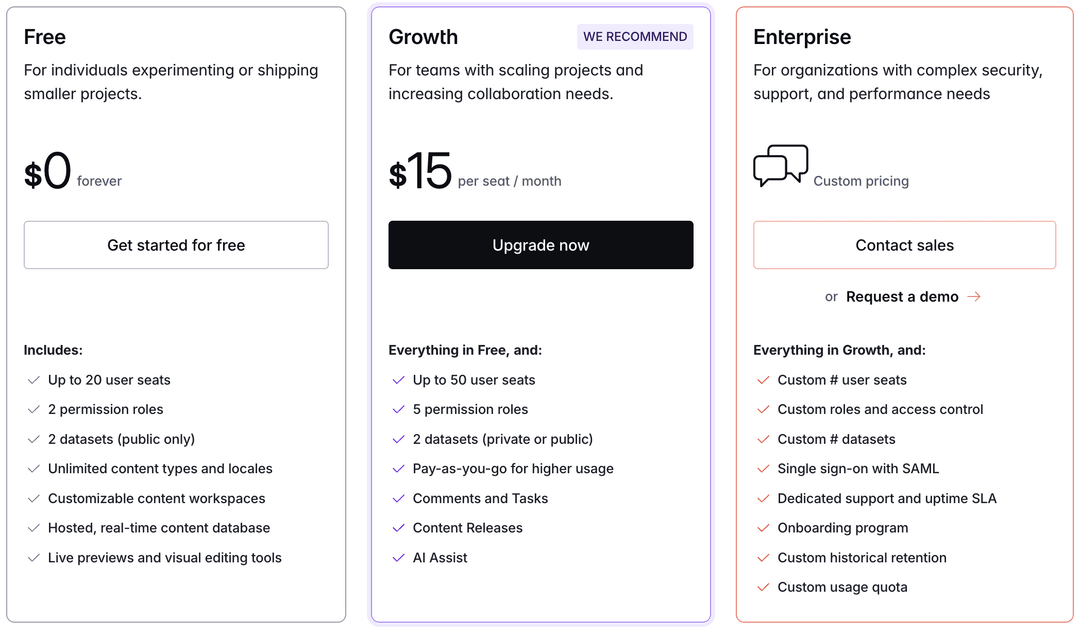
- Free ($0/month): Sanity offers a highly permissive permanent free tier that covers up to 20 user seats, 2 public datasets, and 10,000 documents. It is frequently praised by developers for prototyping and low-traffic production builds, as it relies on hard usage caps rather than surprise overage charges.
- Growth ($15/seat/month): Designed for most commercial projects, this plan supports up to 50 user seats. It unlocks private datasets, increases the document limit to 25,000, and transitions to a pay-as-you-go overage model for bandwidth and API requests.
- Enterprise (Custom Pricing): Required for organizations that need SAML SSO, fine-grained custom roles, custom SLAs, or dedicated data residency requirements.
When budgeting for your 2026 architecture, keep in mind that a marketing team of 10 will cost roughly €174/month on Storyblok’s Growth plan, whereas the same team would cost $150/month on Sanity’s Growth plan.
 Sanity pricing
AI Integration
Both platforms have embraced AI in ways that genuinely transform how teams create and manage content, not just as flashy add-ons but as practical productivity boosters.
Storyblok AI Features
Storyblok’s AI toolkit tackles real-world content challenges:
- AI Translation: No more copy-paste nightmares between translation tools. Translate content naturally across languages using DeepL integration, working at both folder and field levels to maintain your content structure.
- AI Image Generation: Need a custom image but don’t have a designer on hand? Create it yourself with DALL-E right inside Storyblok’s interface.
- AI-Powered SEO: Stop guessing what Google wants. Let AI generate meta tags and optimize your content for better search visibility.
- AI Search: Find exactly what you need with enhanced semantic search through Algolia integration, understanding intent beyond just keywords.
Storyblok isn’t just talking about future AI - they’re letting you play with it today through Storyblok Labs, their innovation playground launched in January 2025. It’s like getting early access to features that will shape tomorrow’s content management.
We’ve seen firsthand how AI can transform content workflows, which is why our team at FocusReactive built an open-source AI SDK for Storyblok. It supercharges Storyblok with OpenAI-powered contextual translation that understands your content’s structure, preserving everything from rich text formatting to complex nested folders.
Sanity AI Capabilities
Sanity takes a different but equally powerful approach, focusing on AI that understands your content’s context and structure:
- AI Assist: Their official plugin isn’t just a bolt-on feature - it’s deeply integrated to help with everything from drafting and editing to translating and optimizing.
- Multilingual Translation: Say goodbye to translation bottlenecks. Sanity’s AI can translate entire documents or just specific fields while keeping your formatting intact.
- Content Generation: Whether you need to create long-form content from scratch or generate multiple variants for A/B testing, Sanity’s AI tools have you covered.
- Vector Search: Find related content based on meaning, not just keywords, with built-in semantic search capabilities.
- Practical AI Guidance: Sanity doesn’t just give you AI tools - they show you how to use them:
- Get step-by-step best practices for implementing AI in your workflows
- Developers can find specialized AI resources and code examples
What makes Sanity’s approach stand out is how they build context into every AI interaction. Their system includes thoughtful features like shareable AI prompts (no more reinventing the wheel for common tasks), permission-based guardrails to prevent AI mishaps, and simple rollback options when AI-generated content needs human refinement.
As AI integration experts, we’ve helped dozens of teams implement custom AI solutions on both platforms. Whether you need semantic search capabilities, natural language processing, or tailored AI model integrations, we can help you move beyond generic AI features to solutions that understand your specific content ecosystem.
Comparison Table
| Feature | Storyblok | Sanity |
|---|---|---|
| Ease of Use | Visual editor, intuitive interface with Storyblok Labs for feature testing | Highly customizable interface with enhanced workflow options |
| Content Modeling | Structured visual approach, accessible to non-technical users | Schema-based system with maximum flexibility and control |
| Integration | Expanded plugin ecosystem with enhanced eCommerce capabilities | Developer-focused APIs with “Content Operating System” approach |
| Scalability | Solid cloud architecture for enterprise needs | Flexible infrastructure suitable for projects of any size |
| Localization | Powerful built-in multilingual tools | Customizable localization framework |
| Developer Experience | Framework-specific guides with intuitive content editor | Code-centric approach with GROQ query language and flexible content modeling |
| Security | ISO 27001 certified AWS hosting with WAF and encryption | Granular access control with OAuth2/SAML and secure token management |
| Support | Clear documentation and active community | Excellent documentation with vibrant developer community |
| Pricing | Tiered model with new Business plan for enterprises | Usage-based approach with flexible scaling |
| AI Features | Translation, image generation, SEO tools, and custom AI SDK by FocusReactive | Context-aware AI Assist with content generation and multilingual capabilities |
Sanity vs. Storyblok: Which Headless CMS Should You Choose?
The right choice between these two platforms comes down to whether your organization prioritizes marketing autonomy or engineering flexibility:
- Choose Storyblok for its powerful visual editor, intuitive content management, and rapid content operations. It is the ideal fit for marketing teams that need to visually assemble and preview pages on the fly.
- Choose Sanity for its highly customizable content model and unparalleled developer control. It is the stronger choice for engineering teams managing complex, structured data architecture across multiple digital touchpoints.
Need an expert second opinion? At FocusReactive, we have delivered enterprise production projects on both platforms. Rather than pushing a single vendor, we evaluate your specific technical requirements, content workflows, and long-term business goals to help you make an objective, future-proof decision.
Book an intro call with our headless CMS expertsto find the exact right fit for your architecture.

 Eugene Boruhov